PV Doctor Research & Publications


Building on our research heritage from the Solar Energy Research Institute of Singapore (SERIS) at the National University of Singapore (NUS), PV Doctor continues to contribute to research and technical studies addressing real-world challenges in PV performance, diagnostics, Smart O&M, asset management, revamping, and repowering.
Explore our latest research papers, conference publications and technical reports below.
|
Published Date
|
Publication / Event
|
Location
|
Publication Title
|
Download Link
|
|---|---|---|---|---|
| Upcoming | BRACIS-36 | Cuiabá, Brazil | A ReAct Agent for Conversational Fault Triage in Solar Asset Management Using RAG and Climate-Aware Reasoning | Upcoming |
| Upcoming | ECPEC-9 | Daejeon, South Korea | Digital Watchdogs and Human-in-the-Loop for PV Smart O&M: Event-Based Evidence from 220 Sites | Upcoming |
| Sep-26 | EU PVSEC | Rotterdam, The Netherlands | Revamping and Repowering of Aging Solar Assets: Performance Drivers, Energy Gains, and Economics from a 14-Year-Old PV System in Tropical Singapore | Download ↓ |
| Jun-26 | IEEE PV Specialists Conference | New Orleans, USA | Automated Performance Evaluation Frameworks: Leveraging Large Language Models for Scalable Service Delivery in Multi-Tiered Solar Asset Management | Download ↓ |
| May-26 | PV Doctor Technical Report | Singapore | Singapore PV Systems Performance Benchmarking Report | Download ↓ |
| Nov-25 | Solar World Congress 2025 | Fortaleza, Brazil | 10 Years of Performance Findings at the Mineirão Stadium Solar Photovoltaic System | Download ↓ |
| Nov-25 | International PVSEC-36 | Bangkok, Thailand | Uncovering Preventable Generation Losses in Thai PV Systems | Download ↓ |
| Nov-25 | International PVSEC-36 | Bangkok, Thailand | Optimizing Solar PV Exports in Singapore and Thailand: Insights from Residential and Commercial Systems | Download ↓ |
| Sep-25 | EU PVSEC |
Bilbao, Spain
|
Detailed Analysis of Degradation Rates of Operating PV Assets in Tropical Climate Conditions | Download ↓ |
Explore the highlights below for a brief overview of each publication, including the research context, key findings, and practical implications for PV asset performance.
Authors: Xiaoqi Xu, André M. Nobre, Qi Ying Ng, Ian Marius Peters and Thomas Reindl
When should an ageing PV system continue operating, undergo targeted revamping, or be fully repowered?
This study examines four co-located rooftop PV systems in Singapore totalling 298 kWp, monitored from 2012 to 2024. The research combines long-term performance analysis, inverter-level diagnostics, on-site inspection and economic assessment to understand why the systems deteriorated and whether partial intervention or full repowering offered the stronger long-term solution.
The systems initially operated at PR values of approximately 0.75–0.85, before entering a pronounced decline after 2018. By 2024, PR had fallen to approximately 0.40–0.60, with an aggregated degradation rate of 2.4% per year, compared with approximately 0.5% per year for a nearby benchmark system.
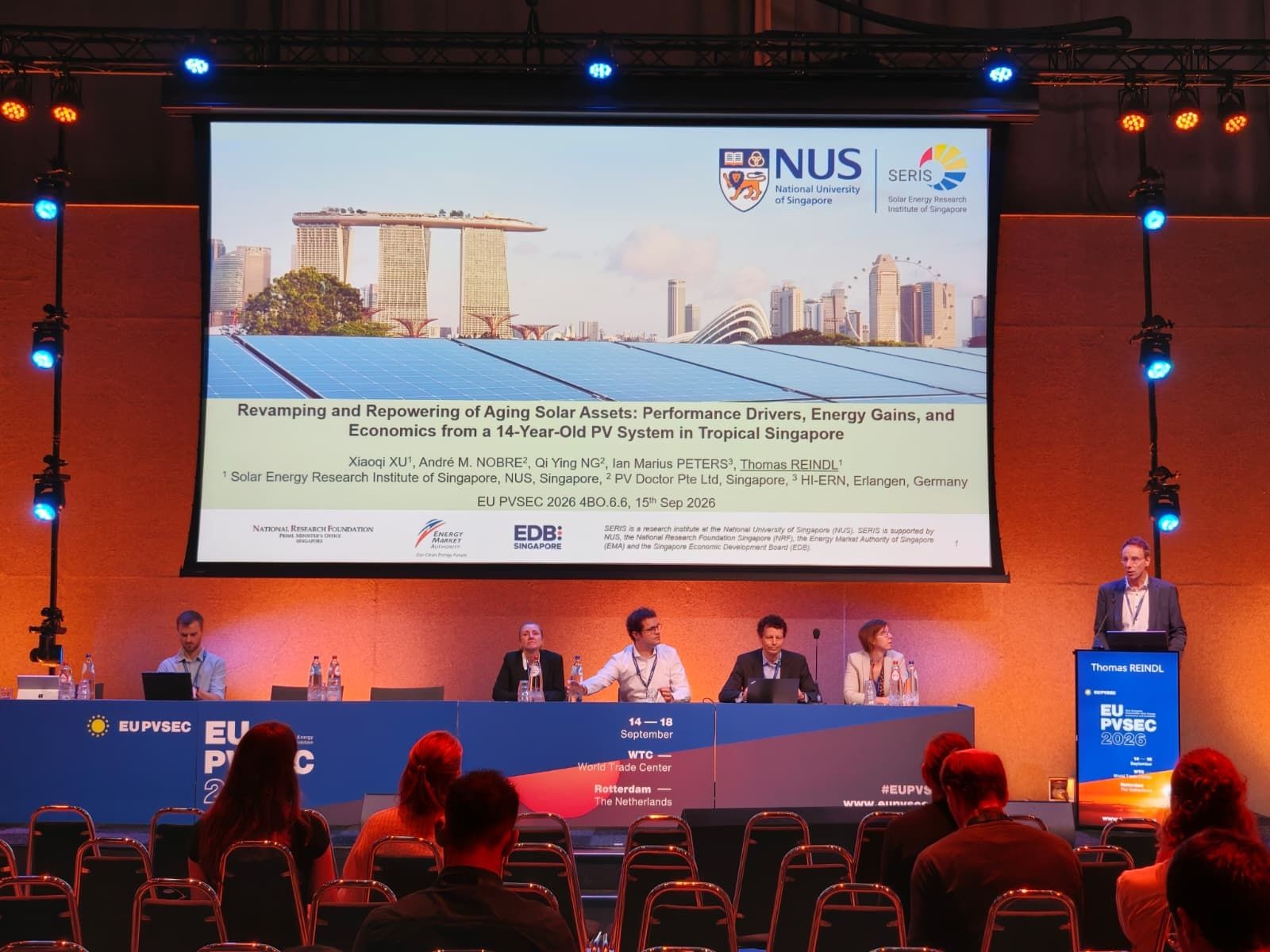
- Partial inverter replacement produced substantial immediate performance recovery. In one system, PR increased from 0.51 to 0.69 (+36.8%), while another intervention restored PR from 0.33 to 0.66 following replacement of two previously non-operational inverters. However, these interventions did not stop the longer-term accelerated decline.
- On-site diagnostics using visual inspection, infrared thermography, I–V curve tracing and electroluminescence imaging identified underlying module and system defects.
- Detailed testing confirmed potential-induced degradation (PID) and irreversible module ageing as major drivers of the persistent performance loss, demonstrating why inverter replacement alone could not fully restore the assets.
- The findings ultimately supported full-system repowering after only 14–15 years of operation, ahead of the expected 20–25-year design lifetime, with the proposed design increasing installed capacity by 51%.
- Under the study assumptions, repowering was projected to increase NPV relative to continued operation by approximately USD 0.02 million over 10 years and USD 0.46 million over 20 years.
The case demonstrates that restoring failed equipment does not necessarily restore the long-term health of an ageing PV asset.
Revamping can recover generation where individual components have failed, but persistent module-level deterioration may continue to erode performance. Determining whether to maintain, revamp or repower therefore requires more than identifying the immediate fault.
Combining long-term performance trends, field diagnostics and economic assessment provides asset owners with a stronger basis for mid-life investment decisions—helping determine when continued maintenance remains justified and when comprehensive repowering may create greater long-term value.
Authors: André M. Nobre, Carlos Alberto Severiano Jr., Manav Gupta, Zhou Yi Zhen, Victor Fernandes and Thiago Moraes
How can solar asset management scale across thousands of systems without requiring engineering resources to grow at the same rate?
This study presents an intelligent service framework combining Large Language Models (LLMs), Retrieval-Augmented Generation (RAG), solar performance analytics, weather data, and human engineering expertise. The framework was deployed across a PV portfolio of more than 2,100 systems and 2 GWp in 22 countries, supporting different levels of automation for residential, fleet and utility-scale assets.
Rather than replacing engineers, the approach uses AI to handle routine communication, data retrieval and preliminary triage, while complex diagnostics and lower-confidence cases are escalated to experienced engineers.

- A three-tier service architecture adapts the level of automation and analytics to different asset types: residential owners, fleet operators and utility-scale plants.
- Historical analysis of a 322-system Singapore fleet found that 80% of reported issues were weather-related non-faults, 12% were transient communication losses, and only 8% represented genuine technical faults.
- Nearest-neighbour analysis helps distinguish shared weather impacts from isolated system underperformance by comparing individual systems with nearby assets operating under similar conditions.
- For utility-scale assets, PV Health Scan maps and ranks inverter-level performance deviations, allowing engineers to identify spatial patterns and persistent underperformance within large plants.
- - The framework separates language processing from numerical analytics: the LLM interprets requests and communicates results, while deterministic analytical routines perform the underlying numerical assessment, helping keep outputs grounded and auditable. (Jun-26) PVSC-54 - Leveraging L…
The study demonstrates how AI can support the scaling of solar asset management without removing the engineer from the decision-making process.
Routine queries, weather-related deviations and preliminary performance triage can be automated, allowing engineering resources to focus on genuine faults and complex diagnostics. At the same time, cross-validation and explicit escalation paths provide safeguards where greater technical judgement is required.
The result is a human-in-the-loop approach to Smart O&M, where automation improves service scalability while specialist analytics and engineering expertise remain central to performance assessment.
Authors: PV Doctor Pte. Ltd.
This report benchmarks real-world solar PV performance in Singapore using full-year 2025 operational data from 650+ systems, drawn from PV Doctor’s wider Singapore portfolio of approximately 300 MWp across 1,000+ sites. It examines how actual performance varies across assets and what factors contribute to the gap between expected and actual generation.
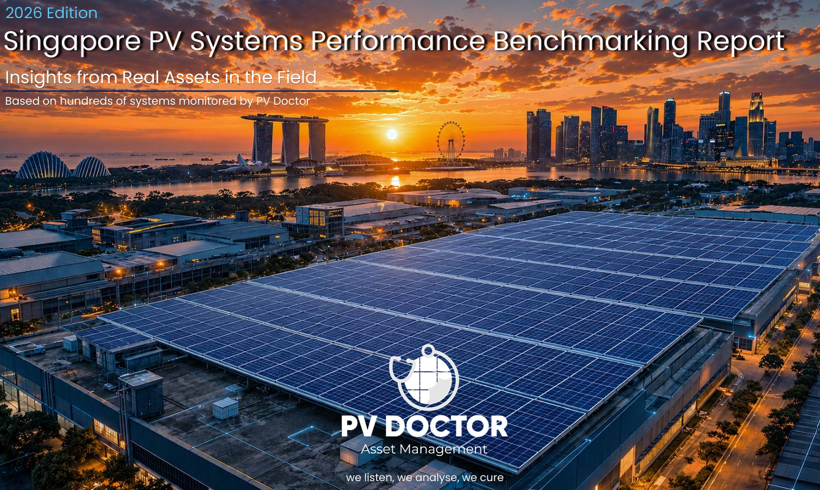
- Singapore’s portfolio recorded an average annual specific yield of ~1,159 kWh/kWp, with considerable variation across systems.
- Residential systems averaged ~1,154 kWh/kWp, compared with ~1,171 kWh/kWp for C&I systems, despite being younger on average.
- System age alone was not a dominant driver of performance; design, shading, soiling, maintenance and operational practices were important contributors.
- The report identifies recurring loss factors including soiling, water marks, design constraints and technical issues, many of which can be detected and addressed.
- Real cases demonstrate recoverable value, including an inverter repowering case that restored PR from approximately 5% to 65%, and a Smart O&M case delivering a 3.4% weather-adjusted annual performance gain.
As Singapore’s solar market matures, value creation increasingly depends not only on adding capacity, but on understanding, benchmarking and improving the performance of existing assets. The report demonstrates how portfolio-scale operational data can identify performance gaps and help prioritise actions to recover avoidable losses.
Authors: André M. Nobre, Juliano Marcial Fraga Fonseca, Clarissa D. Zomer, Rafael Corrêa Imbuzeiro and Carlos Alberto Severiano Jr.
How does a large PV system integrated into a complex landmark structure perform after more than a decade of operation?
This study evaluated 10 years of operational performance from the 1.42 MWp PV system at Mineirão Stadium in Belo Horizonte, Brazil, comprising 5,910 PV modules across approximately 9,500 m² of roof area. The research combined 3D shading simulations, empirical inverter data, long-term Performance Ratio (PR) analysis and field IV curve measurements to investigate shading impacts and system ageing from 2014 to 2024.
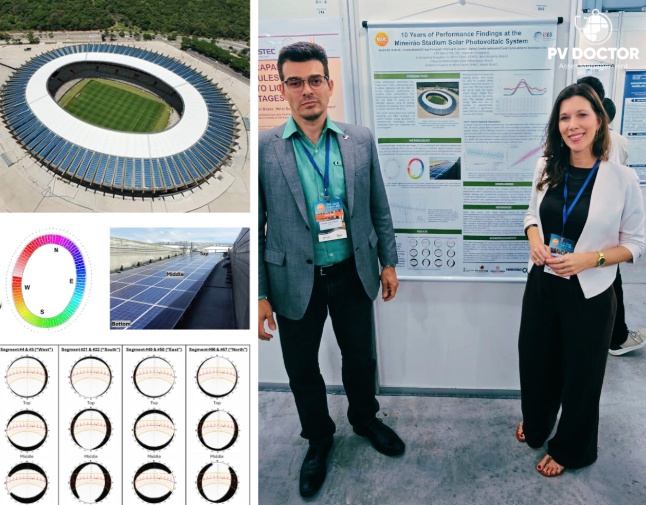
- Despite the stadium's complex curved architecture, simulations estimated an average annual energy yield loss from shading of approximately 2.8% across the system.
- Geometric shading and actual energy loss were substantially different: the average overcast-sky shading factor was 12.3%, demonstrating that visible or geometric obstruction does not translate directly into proportional generation loss.
- Long-term PR analysis indicated a system-level performance degradation rate of approximately -1.6% per year over more than a decade of operation.
- Field IV curve measurements across 46 strings indicated a lower module/string-level degradation of approximately -1.0% per year, suggesting that the broader system-level decline also reflects factors such as inverter performance, wiring losses, soiling and maintenance conditions.
- Satellite irradiation data showed a strong correlation (R² = 0.981) with a nearby meteorological station, supporting its use for long-term performance trending where reliable on-site irradiance measurements were unavailable.
The findings demonstrate the importance of combining engineering models with actual operational data when assessing ageing PV assets. Geometric shading alone can overstate its impact on energy production, while system-level degradation should not automatically be interpreted as module degradation.
The study also highlights how O&M strategies need to evolve as assets age. At Mineirão Stadium, difficult roof access and limited water availability made conventional cleaning challenging, leading to the deployment of robotic cleaning systems. Together with satellite-based performance monitoring and targeted field measurements, these approaches can support the continued operation of complex PV installations as they enter their second decade.
The Mineirão case demonstrates that PV integrated into architecturally complex and legacy structures can maintain long-term operation, provided that performance is properly assessed and O&M strategies are adapted to the site's specific conditions.
Authors: Thornthanut Pakdeepinyo, Jason Ward and André M. Nobre
How much energy can PV systems lose when performance issues remain undetected or unresolved?
This study analysed 225 PV systems across Thailand with a combined capacity of 34.7 MWp, covering commercial, educational, industrial, large-scale and residential installations. Actual system performance was benchmarked against expected Performance Ratio (PR) to quantify the performance gap and its financial impact.
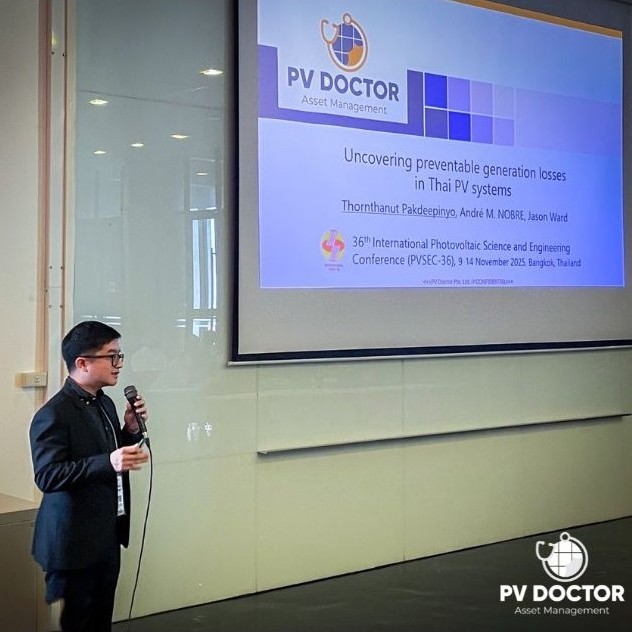
- Across the portfolio, the average actual PR was 59.5%, compared with an expected PR of 73.2%, representing a 13.7% performance shortfall.
- The estimated annual energy loss was approximately 7.1 GWh, equivalent to around THB 28.3 million per year based on an average electricity tariff of THB 4/kWh.
- Industrial systems accounted for more than 80% of the portfolio's estimated financial losses, with approximately 5.7 GWh/year of estimated energy loss.
- Performance gaps varied considerably by system category, demonstrating the importance of understanding the operating conditions and loss mechanisms of individual assets rather than relying only on portfolio-level averages.
The study highlights the economic value of proactive PV asset management and the need to distinguish between different sources of performance loss.
It also introduces PV Doctor's Smart Generation Replicator (SGR) as a developing approach to reconstruct the generation profile that could have occurred without curtailment. Separating curtailment from other losses can help asset managers better identify and prioritise actionable opportunities such as cleaning optimisation, inverter monitoring and other targeted O&M activities.
Authors: André M. Nobre, Ratwade Dhithijaiyratn, Marta Millan, Cyndi Tiong, Manav Gupta, Thornthanut Pakdeepinyo, Jason Ward and Xiaoqi Xu
How do electricity consumption patterns and export regulations affect the value of rooftop solar?
This study examined actual PV generation and export behaviour from 46 residential systems in Singapore and 8 residential systems in Thailand, together with a 300 kWp commercial rooftop system in Singapore equipped with battery energy storage. The analysis explored how solar irradiation, consumer load profiles, weekday/weekend behaviour, electricity pricing and different regulatory frameworks influence how much solar energy is consumed on-site or exported to the grid.
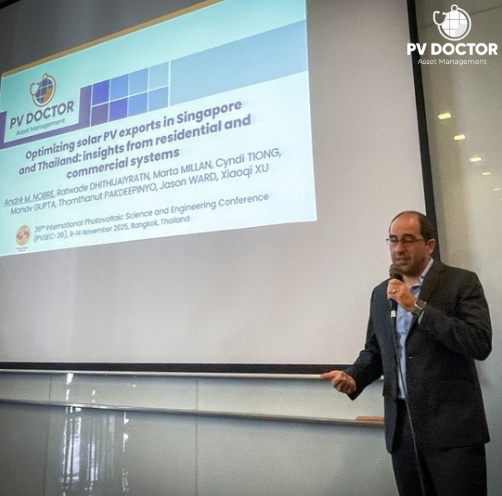
- Residential PV systems in Singapore exported an average of 63% of their generated solar energy, while the Thai systems studied exported approximately 20%, despite Thailand having 10–15% higher annual irradiation.
- The difference was strongly influenced by the regulatory environment: Singapore permits unrestricted export, while export restrictions affecting many Thai rooftop systems can result in generation curtailment when on-site demand is insufficient.
- For the 300 kWp commercial system in Singapore, exports were lower during weekdays when operational loads were present, but increased to approximately 70–80% on weekends and public holidays when the facility was largely unoccupied.
- Singapore's half-hourly wholesale electricity prices showed substantial variation over time, creating a relevant context for evaluating the potential role of battery storage, managed EV charging and other flexible-load strategies.
PV export behaviour is not determined by solar resource alone. System sizing, consumer load profiles, operating schedules, electricity-market conditions and export regulations all influence how effectively available solar generation can be utilised.
Understanding these patterns becomes increasingly important as battery storage and EV charging expand. Detailed generation, consumption and export data can support better decisions around system sizing, battery dispatch, managed EV charging and demand-response strategies, helping maximise the utilisation and value of distributed solar generation.
The comparison also demonstrates how different regulatory frameworks can materially affect PV system operation: unrestricted export provides greater flexibility, while export limitations can lead to otherwise available solar generation being curtailed.
Authors: Xiaoqi Xu, André M. Nobre, Han Cao, Yu Xu, Ian Marius Peters and Thomas Reindl
How quickly do operating PV systems actually lose performance under tropical conditions?
This study evaluated long-term performance data from 35 PV systems across seven countries, representing 22.3 MWp of installed capacity. The portfolio covered residential, commercial and industrial systems, with datasets spanning approximately 2 to 11.7 years.
The analysis included different crystalline-silicon and thin-film technologies, module configurations, installation types and tropical climate zones, providing a diverse real-world dataset for assessing long-term PV performance loss.
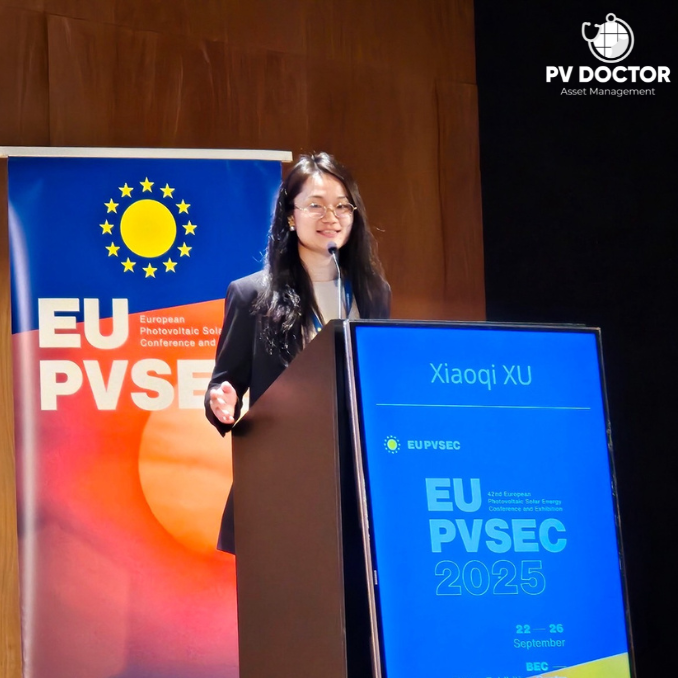
- Across the systems studied, the mean performance change was -1.41% per year, while the median was -1.10% per year.
- The observed performance loss rates were higher than the 0.7–1.0% per year assumptions often used for PV systems in tropical climates.
- The analysis found a trend towards accelerating performance losses as systems age, suggesting that observations based primarily on newer PV systems may underestimate long-term degradation.
- Performance was evaluated across a diverse portfolio covering different PV technologies, module types, installation configurations and tropical operating environments.
Long-term PV performance may not necessarily follow a simple, constant annual degradation assumption.
For asset owners, investors and performance engineers, the findings highlight the importance of reassessing degradation assumptions as PV assets mature, particularly when forecasting long-term generation, evaluating remaining asset life or developing financial models.
The study also provides a foundation for further investigation into the root causes of higher performance loss rates in tropical climates, supporting the development of more appropriate strategies for maintaining the long-term performance and reliability of PV systems.
PV Doctor is a solar performance analytics and asset management company, spun off from the Solar Energy Research Institute of Singapore (SERIS) at the National University of Singapore (NUS). Built on years of solar research and real-world operational expertise, PV Doctor helps asset owners maximise energy yield and reduce performance losses across global solar portfolios.
บล็อคที่เพิ่งดูไป